How long does land registry take?
Last updated: 4 November 2026. This guide covers England and Wales.
You’ve agreed a price, the removal van is pencilled in, and then someone mentions the Land Registry. Suddenly you’re wondering if a government office in another city is about to stall your move. So, how long does land registry take, and how much of that wait is down to HM Land Registry?
Here’s the short answer. Most of the time it takes to buy or sell a home comes from the chain, searches, mortgage checks and enquiries. The Land Registry checks that happen before completion are usually quick. The slow part comes after you’ve got the keys, when the register is updated with the new owner. And the most common avoidable hold-up at that stage is surprisingly simple: missing identity evidence.
The good news is that you can help prevent most of these problems in the first week of your move.
How long does conveyancing take, and where does the Land Registry fit in?
For a typical home move, conveyancing runs from the day your offer is accepted to the day you complete. [ADD CHAPTER LAW AVERAGE: typical weeks from instruction to completion, from your own case data.] For a full stage-by-stage breakdown, see our guide on how long conveyancing takes in the UK.
HM Land Registry (HMLR) is the government body that keeps the official record of who owns land and property in England and Wales. It touches your move at two points.
First, before completion, your conveyancer downloads copies of the title and carries out an official search. These are fast. According to HMLR’s published processing times (updated 30 October 2026), 91.8% of these information requests are dealt with in a day.
Second, after completion, your conveyancer applies to register you as the new owner. This is where the waiting happens. HMLR says over half of standard applications to update the register take 19 weeks, with most completed in about 9 months.
| Stage | What HMLR does | How long it takes (HMLR figures, October 2026 update) |
|---|---|---|
| Before exchange and completion | Official copies of the title and official searches | 91.8% done in one day |
| After completion: most resales | Registers the transfer and any new mortgage | Over half take 19 weeks; most done in about 9 months |
| After completion: new builds and new leases | Splits an existing title or registers a new lease | Half done in about 9 months |
That sounds alarming, but there’s an important reassurance. HMLR states that your legal interest is protected from the moment it receives the application, however long it then takes to process. In other words, you can live in your home while registration catches up.
What is a Land Registry requisition, in plain English?
A requisition is HMLR asking for more information, or for something to be fixed, before it can finish an application. Think of it as a form being handed back with a note saying “this bit is missing”.
Some requisitions can’t be helped. However, HMLR calls many of them “avoidable” because a careful check before sending the application would have caught the problem. Typical examples include missing identity evidence, names that don’t match, unclear plans and missing documents.
Each requisition adds time. Your conveyancer has to gather the answer, and sometimes that means coming back to you.
What does HMLR’s latest data show?
On 2 November 2026, HMLR published new avoidable requisitions data. The headline figures are encouraging:
- Between January and September 2026, HMLR raised around 94 avoidable points per 1,000 applications. That rate is 11% lower than in 2025.
- Avoidable points fell from around 839,000 in 2022 to 439,000 in 2025, a drop of 47.7%.
- Missing or unclear information is now the biggest broad category.
- Identity evidence not being supplied is the most common single avoidable point.
One detail is easy to misread. HMLR counts “points”, and one requisition can contain several points. So 94 points per 1,000 applications does not mean 9.4% of applications had a problem. HMLR makes this clear in its own notes.
Still, the direction is clear. Conveyancers are sending cleaner applications, and the remaining issues are mostly about information that wasn’t there at the start.
Why does missing ID top the list?
HMLR needs proof that the identity of each person involved has been properly checked. When a conveyancer acts for you, they usually confirm this themselves. In other cases, such as when someone on the other side has no conveyancer, an identity form may be needed. HMLR’s evidence of identity guidance sets out when each applies.
If that confirmation or form is missing or incomplete, HMLR raises a requisition. Honestly, it’s one of the most frustrating delays because it’s so preventable.
When does a Land Registry delay actually affect you?
When people ask how long does conveyancing take, they usually mean “when can I move in?” For many buyers, a slow registration after that point is invisible. You’ve moved in, your rights are protected, and the register updates in the background. But there are situations where it matters more:
- You plan to sell or remortgage soon. A buyer’s conveyancer or a new lender will want to see a settled title, so an open application can slow your next transaction.
- You’re buying a new build or a new lease. These are more complex registrations. HMLR says between 55% and 65% of these complex applications need clarification or more information.
- Your name doesn’t match across documents. A married name on your passport and a maiden name on the old title, or a middle name used on one form and not another, can trigger questions.
- You’re changing who owns the property. A transfer of equity still needs a clean application, even when no money changes hands.
If a delay could put a sale or other transaction at risk, your conveyancer can ask HMLR to fast-track it. HMLR offers this “expedite” service for free and says it processes the vast majority of expedited applications within 10 working days.
What can you do to stop your move getting held up?
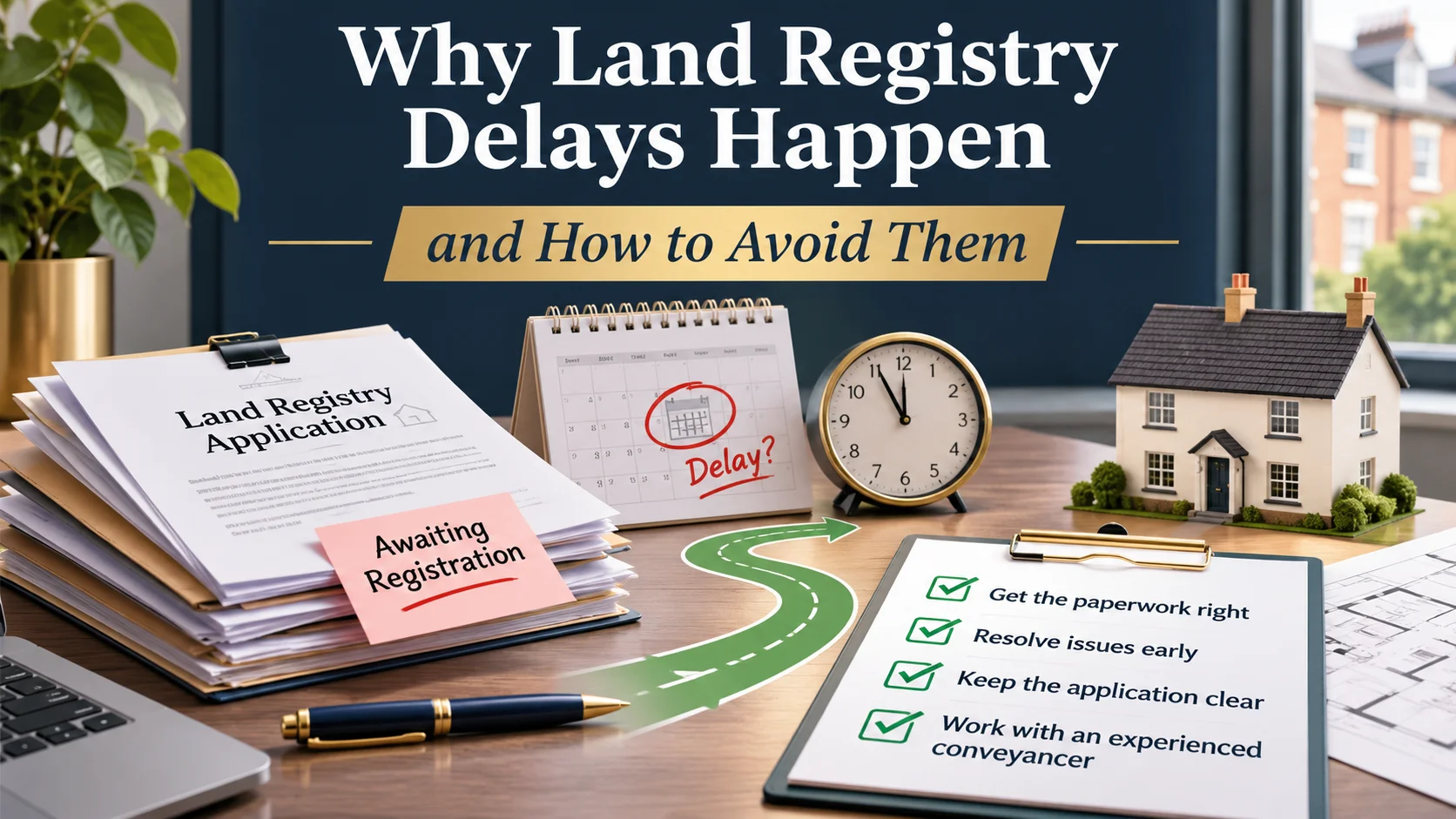
You can’t control every part of how long conveyancing takes, but you can control your own paperwork. Most avoidable requisitions start with information that arrived late or not at all. Therefore, the most useful thing you can do is front-load the paperwork. Here’s a practical checklist.
- Complete your ID checks in the first few days. Use documents that are in date, and make sure the name matches exactly what will go on the transfer.
- Flag any name changes early. Tell your conveyancer about marriage, divorce, deed poll changes or different spellings across your documents.
- Sellers: gather documents before you list. Guarantees, planning permissions, building regulations certificates and any leasehold paperwork are much easier to find before a buyer is waiting.
- Mention anything unusual. A power of attorney, a property held in trust or someone selling on behalf of a relative who has died all need extra evidence.
- Reply to questions quickly. A query left for a week becomes a week added to the whole chain.
None of this is complicated. But it’s often the difference between a move that keeps ticking along and one that stops while everyone waits for a single document. For more on what slows transactions down, read our guide to common conveyancing problems and how to avoid them.
How does Chapter Law keep your move moving?
Chapter Law is a conveyancing firm based in Birmingham. Our licensed conveyancers, backed by qualified solicitors, help buyers and sellers across Birmingham, Bromsgrove and the wider West Midlands on a fixed fee.
We start identity checks at the beginning of your case, not when the paperwork is nearly ready. As a result, we can spot a name mismatch or a missing document while there’s still plenty of time to sort it.
You also get a dedicated case manager and access to our app. Through the app you can check your progress, upload documents and sign paperwork whenever it suits you. So instead of chasing calls, you can see where things stand and send what’s needed straight away.
Whether you’re buying a home or selling a property, the aim is the same: get the right information in early so the Land Registry has nothing to send back.
Side note: HMLR is consulting on its fees
HMLR is also consulting on restructuring its fees until 22 December 2026. The main proposal would replace value-based fees with two fixed fees: one for ownership changes where full market value isn’t paid, and one for registering a mortgage. HMLR’s reasoning is that value can be hard to work out in these cases, which leads to requisitions.
For a standard purchase, nothing changes yet. HMLR is only gathering early views on fees for sales at market value and says this is not a proposal. We’ll update this guide if anything changes.
Frequently asked questions
How long does conveyancing take if the Land Registry raises a requisition?
It depends on when it happens and how quickly the answer can be found. Most requisitions arise after completion, so they delay registration rather than your move. A simple missing document can be fixed quickly, while a name or plan problem may need more evidence.
Can the Land Registry stop me completing on my house?
Rarely. The HMLR checks needed before completion are usually done within a day. Most Land Registry waiting happens after completion, when your ownership is being registered.
Is my ownership safe while registration is pending?
Yes. HMLR says the applicant’s legal interest is protected from the moment it receives the application, as long as the application is in order. That’s why accurate paperwork matters.
Why is my conveyancing taking so long if the Land Registry is quick?
Before completion, the usual causes are the chain, local searches, mortgage checks and enquiries between the two conveyancers. Late ID or missing documents can add to that at any stage.
Can I check whether my registration has finished?
Yes. Your conveyancer will tell you when registration is complete. You can also ask us for an update through the app at any time.
Get a fixed-fee conveyancing quote
So, how long does conveyancing take? Less time when the right information is there on day one. Get a fixed-fee conveyancing quote and track your move in our app, or talk to our team if you’d like to ask a question first.
This guide is general information, not legal advice for your situation. Timescales depend on your property, your chain and the other parties involved.