Last updated: 28 October 2026. This guide covers England and Wales.
You’ve found the right place. The price looks good, maybe a little too good, and then the agent mentions the lease has 68 years left. That’s the moment most buyers either walk away or push on without really knowing what they’re taking on.
Buying a house with a short lease can work out well. But before you offer, check the exact years left, the ground rent terms, the service charges and any planned works, and the likely cost of extending. Confirm your lender’s minimum lease term early, too. Under current rules, a lease at 80 years or less carries “marriage value”, which makes extending noticeably more expensive. All of that belongs in your offer price.
The rest of this guide walks through each check, what tends to go wrong, and the questions worth asking before you commit.
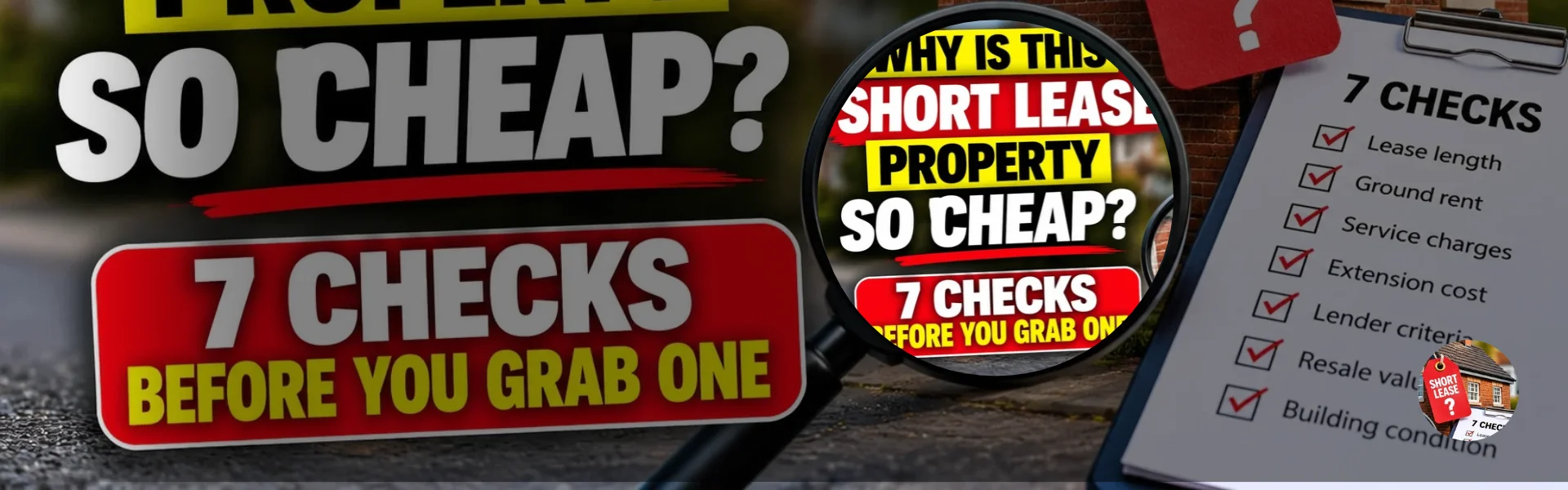
The short version: 7 checks before you offer
- Years remaining. Get the exact unexpired term from the lease or title register, not the agent’s rounded figure.
- The 80-year line. Below it, extending costs more under the rules in force today.
- Ground rent. Check the current amount and how it rises, especially doubling or RPI-linked clauses.
- Service charges. Ask for at least three years of accounts, the reserve fund balance and any planned major works.
- Extension route and cost. Get a lease extension valuation before you settle on a price.
- Mortgage acceptance. Your lender’s minimum lease term may apply at the start of the mortgage and at the end.
- Resale. Think about how short the lease will be when you come to sell.
What counts as a short lease?
There’s no legal definition. In practice, most people in the property world treat a lease under 80 years as short, and many get uneasy below about 90 years because the lease is heading for that line.
The number that matters is the unexpired term, meaning the years left today. A lease granted for 99 years in 1985 isn’t a 99-year lease anymore. It has roughly 58 years left, and it loses another year every year you own it.
So don’t trust a listing that says “long lease” or “approx. 70 years”. Ask for the start date and original length, then do the maths yourself. Your conveyancer will confirm it from the lease and the title register, but you want a rough figure before you start negotiating.
Why 80 years matters: marriage value explained
When you extend a lease, you pay the freeholder a sum called a premium. If the lease has more than 80 years left, that premium mostly reflects the ground rent the freeholder gives up and the value of getting the property back at the end.
Once the lease reaches 80 years or less, a third element kicks in. Marriage value is the jump in the property’s value that comes from extending the lease. Under the current rules, the freeholder is entitled to half of it. On a short lease, that can make the premium much bigger, and it grows as the lease shrinks.
Hasn’t marriage value been abolished?
On paper, yes. In practice, not yet. The Leasehold and Freehold Reform Act 2024 abolishes marriage value and brings in a 990-year extension term. However, as of October 2026 those changes are still not in force. The government’s consultation on the new valuation rates closed on 21 October 2026, and the Leasehold Advisory Service reports that the Prime Minister plans to bring the follow-up Commonhold and Leasehold Reform Bill to Parliament before Christmas 2026.
No start date for the valuation changes has been published. So if you buy a property with a 72-year lease today, price it on the rules that apply today. Treat any future saving as a bonus, not as part of your plan. Before you exchange, ask your conveyancer to confirm the current position, because this is moving.
Ground rent: the clause that can block a sale
Ground rent gets less attention than lease length when buying a house with a short lease, but it matters just as much. It’s the yearly sum you pay the freeholder simply for holding the lease. On older leases it’s often small. The trouble usually lies in how the rent increases, rather than what you pay now.
Read the review clause carefully. Watch for rent that doubles every 10 or 15 years, rent linked to RPI with frequent reviews, and rent linked to the property’s value. A modest £150 a year can look very different 20 years from now.
What lenders look for
Lenders set their own rules on ground rent. According to the government’s January 2026 policy statement on ground rents, rent above 0.1% of the property’s value or above £250 a year is a common point at which lenders start adding extra checks. For a flat worth £200,000, 0.1% is £200 a year. Those checks can slow a purchase down or stop it altogether.
Two things many guides still get wrong
First, the old “AST trap” has gone. Until recently, a long lease with ground rent above £250 a year (£1,000 in Greater London) could be treated as an assured shorthold tenancy, which gave the freeholder stronger possession rights over rent arrears. The Renters’ Rights Act 2025 ended that from 27 December 2025 by excluding long leases from the assured tenancy rules. If someone warns you about it, the risk no longer applies, although lenders may still have their own ground rent limits.
Second, the proposed £250 ground rent cap isn’t law. The draft Commonhold and Leasehold Reform Bill would cap ground rent on most existing leases at £250 a year, then cut it to a peppercorn (effectively zero) after 40 years. The Leasehold Advisory Service says the cap could arrive in 2028, subject to Parliament. Until then, the ground rent in the lease is the ground rent you pay.
Service charges: the cost buyers underestimate
Service charges pay for the upkeep of the building and shared areas, plus insurance and management. Unlike ground rent, they can change a lot from year to year, and a big repair bill can land soon after you move in.
Ask for these before you offer, or at least before you’re committed:
- Service charge accounts for the last three years, so you can see the trend.
- The current year’s budget and what you’d pay.
- The reserve (or sinking) fund balance. A healthy fund means less risk of a sudden large bill.
- Any planned or proposed major works, such as a roof, lift, windows or external decoration.
- Any disputes between leaseholders and the freeholder or managing agent.
Major works come with a legal safeguard. If works will cost any one leaseholder more than £250, the landlord has to run a formal Section 20 consultation first. If you see a Section 20 notice in the paperwork, a large bill is likely on the way. Find out who pays it, you or the seller, and get that agreed in writing.
The government’s How to Lease guide also tells buyers to ask their conveyancer to make sure the seller has paid all service charges in full. Arrears can become your problem if nobody checks.
Can you extend the lease, and who should pay?
Usually, yes, and for anyone buying a house with a short lease, an extension is the usual fix. Under current law, the owner of a qualifying flat can extend by 90 years on top of the remaining term, with ground rent reduced to a peppercorn. The owner of a qualifying leasehold house can extend by 50 years or, often better, buy the freehold outright.
One big change helps buyers. You used to need to own the property for two years before using the legal right to extend. That rule was scrapped on 31 January 2025, so you can now start a claim as soon as you complete.
| Option | How it works | What to watch |
|---|---|---|
| Seller extends before completion | The seller finishes the extension and you buy with a long lease. | Can delay the sale. Check the new lease terms, not only the length. |
| Seller starts a claim and passes it to you | The seller serves the formal notice and assigns the claim to you on completion. | Needs careful drafting by both conveyancers. Agree who pays the costs. |
| You extend after you buy | You start the statutory claim straight after completion. | You carry the cost and the risk. Your price should reflect both. |
| Informal deal with the freeholder | You negotiate a new lease outside the statutory process. | Can be quicker, but terms may include new or rising ground rent. |
Whichever route you choose, you’ll normally pay your own legal and valuation fees and, under the current rules, a share of the freeholder’s reasonable costs too. The Leasehold Advisory Service runs a free lease extension calculator for flats. It gives a ballpark figure. For a price you can negotiate with, get a valuation from a surveyor who handles lease extensions.
For a related walkthrough, see our guide to extending a lease.
Will you get a mortgage on a short lease?
Possibly, but it depends heavily on the lender. Mortgage rules are where buying a house with a short lease most often stalls. There’s no single industry cut-off. Each lender publishes its own minimum in Part 2 of the UK Finance Mortgage Lenders’ Handbook, and the answers vary widely.
Some lenders ask for around 70 years from the start of the mortgage. Others want 85. Many also apply a second test: a minimum number of years left when the mortgage ends. Published answers include 45, 50 and 55 years. That second test catches people out.
Here’s what that looks like. Say a lease has 72 years left and you want a 25-year mortgage. That lease passes a “70 years at the start” rule. But it fails a rule that requires 50 years left at the end, because only 47 would remain. Same property, different answer.
So talk to a mortgage broker before you offer, not after. Give them the exact lease length and the ground rent terms. A mortgage adviser can tell you which lenders are realistic and whether an extension needs to happen first.
Cash buyers skip this hurdle, but they still face it at resale. Your future buyer will probably need a mortgage, and the lease will be shorter by then.
Is a leasehold house different from a leasehold flat?
Yes, in a few useful ways. Most houses in England and Wales are freehold, so a leasehold house is the exception rather than the rule. If you’re looking at one, ask why it’s leasehold. The answer might be a shared ownership scheme, a new-build estate, or an old estate lease from decades ago.
The good news for house buyers is the freehold route. Many leasehold house owners have a legal right to buy the freehold. That often solves the short-lease problem completely, because you end up owning the house outright with no lease to run down. Ask your conveyancer whether the house qualifies, and get a rough cost before you offer.
With a house, there’s usually less shared upkeep. Still, check for estate charges on newer developments. These can work like service charges for roads, green spaces and lighting.
Questions to ask before buying a house with a short lease
Different people hold different answers. Here’s who to ask what.
Ask the estate agent or seller
- How many years exactly are left on the lease, and when did it start?
- Has the seller started a lease extension or freehold claim? Would they assign it to me?
- Would the seller extend before completion, or reduce the price instead?
- What are the current ground rent and service charges, and when did they last change?
- Are any major works planned or already underway?
- Why is the property priced where it is? Has the short lease already been factored in?
Ask your conveyancer
- What does the ground rent review clause say, and could it cause lending problems?
- Does the property qualify for a statutory lease extension or freehold purchase?
- Are there any service charge arrears, disputes or Section 20 notices?
- Are there unusual restrictions in the lease, such as limits on letting, pets or alterations?
- What is the current position on leasehold reform, and does it affect this purchase?
Ask your surveyor or valuer
- What would a lease extension or freehold purchase likely cost here?
- What would the property be worth with a long lease?
- How much is the short lease knocking off the value today?
Ask your mortgage broker
- Which lenders will accept this lease length for my mortgage term?
- Do any lenders I’m considering have ground rent limits this lease breaks?
- Would extending first open up better options?
If you’d like help with the legal side, our conveyancing team can check the lease before you commit.
How a short lease should shape your offer
When buying a house with a short lease, the lease itself isn’t a reason to walk away. It’s a reason to price carefully. The discount should cover what it will cost you to fix the lease, plus some allowance for hassle and risk.
A sensible way to think about it is to start with what the property would be worth with a long lease. Then take off the likely extension premium, your legal and valuation fees, and the freeholder’s costs you’ll probably have to cover. Finally, allow something for the time and uncertainty involved. If the asking price is already well below that figure, it may be a fair deal. If it isn’t, you have a clear reason to negotiate.
Honestly, this is where most buyers leave money on the table. They see a property priced below its neighbours and assume the short lease is already “priced in”. Sometimes it is. Often it isn’t, because the seller hasn’t had a valuation done either.
Getting a lease extension valuation before you offer costs a little up front. But it turns a vague worry into a number you can put in front of the agent.
Frequently asked questions
Is a 99-year lease a short lease?
It depends on how many years are left, not the original term. A 99-year lease granted recently is long. One granted in the 1980s may now have under 60 years left, which most lenders and buyers would see as short.
Should I wait for marriage value to be abolished before extending?
That’s a judgement call, and nobody can tell you when the change will start. Waiting carries its own cost, because the lease gets shorter every year and the premium can rise. Get a valuation and personal advice before you decide to wait.
Can I buy a short lease property with cash and extend later?
Yes, and some buyers do this to secure a lower price. Since January 2025 you can start a statutory claim straight after completion. Just make sure you’ve budgeted for the full extension cost, not only the purchase price.
Does a short lease always mean a bargain?
No. A lower asking price can still be too high once you add extension costs, fees and risk. Compare the price with the long-lease value minus those costs before you decide.
Next step: check the lease before you commit
Buying a house with a short lease can be a smart move if you go in with real numbers. Get the exact term, read the ground rent clause, ask for the service charge history, test the lease against your lender’s rules, and get the extension priced. Then make an offer that reflects all of it.
If you’ve found a property and want the lease checked before you offer, get in touch with our team.
This guide is general information about leasehold property in England and Wales. It isn’t legal or financial advice. Leasehold law is changing, so get advice on your own situation before you make an offer.