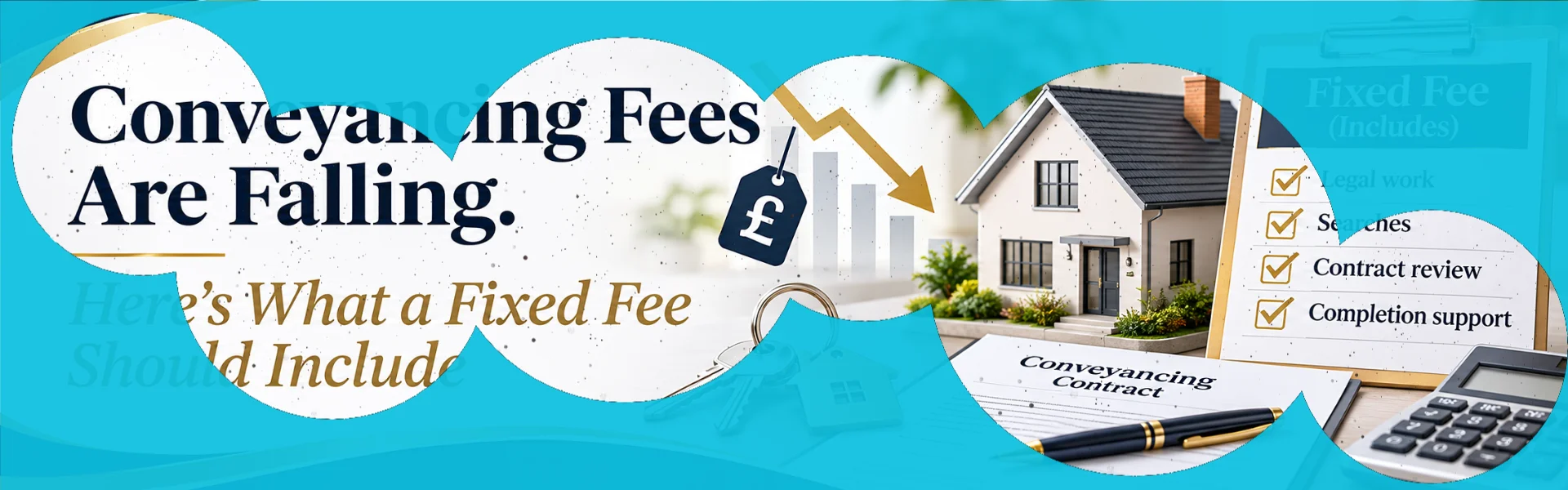
What Do Conveyancing Fees Include? A fixed conveyancing fee should cover all the legal work needed to reach completion, including registering you at HM Land Registry and filing your Stamp Duty return. Alongside it, a good quote lists each disbursement, the VAT on every item, any supplements that might apply and the assumptions behind the price.
Conveyancing quotes have been getting cheaper. Reallymoving’s analysis of more than 77,000 quotes, reported by Property Industry Eye, shows the average combined sale and purchase falling 3% in the third quarter of 2026 to £2,365, including VAT and disbursements. The West Midlands recorded the biggest quarterly fall, at 9.3%. Lower prices help you, but they also make the small print matter more. This guide shows you how to check what a fixed fee really covers. For average costs by transaction type, see our guide to how much conveyancing costs.
The three parts of every conveyancing quote
Every quote breaks down into three parts. Once you can see them separately, comparing firms gets much easier.
- The legal fee. The firm’s charge for its own work. This part stays fixed, and it varies most between firms.
- Disbursements. Money the firm pays to other organisations for you, such as search providers and HM Land Registry. These should look broadly similar whichever firm you choose.
- Supplements. Extra charges for specific extra work, such as a leasehold flat, a new build or a gifted deposit.
A low legal fee with several supplements on top can easily cost more than a higher fee that covers everything. So the useful comparison is always the total for your type of property, not the first line of the quote.
What do conveyancing fees include? A line-by-line checklist
Use this table to check any quote you receive. Each row shows where an item belongs and what to ask about it.
| Item | Where it belongs | What to check |
|---|---|---|
| Legal fee for the transaction | In the fixed fee | Does the quote show the VAT amount? Does the price assume freehold or leasehold? |
| Exchange, completion and registration | Inside the legal fee | Paying off your mortgage on a sale, and registering you as owner on a purchase |
| Stamp Duty return | Filing sits inside the legal fee | The tax itself goes to HMRC and appears on its own line |
| Searches | Listed as a disbursement | Which searches the pack contains |
| HM Land Registry fees | Listed as a disbursement | Whether the figure matches your price band |
| ID and anti-money laundering checks | Listed separately | The cost per person, and whether VAT applies |
| Bank transfer fees | Listed separately | The cost per transfer, and how many transfers |
| Supplements | Listed as “if required” | Leasehold, new build, shared ownership, gifted deposit, Help to Buy or Lifetime ISA |
| Leasehold charges set by the lease | Listed as estimates | Notice fees, deed of covenant and certificate of compliance, which the landlord or managing agent sets |
| Assumptions | Stated in writing | What happens if the work turns out more complicated |
| Abortive terms | Stated in writing | What you pay if the move falls through |
What must a conveyancer tell you about price?
Both main regulators of residential conveyancers require firms to publish price information, and the rules overlap closely.
Firms regulated by the SRA
The SRA’s transparency guidance lists what solicitor firms must publish for residential conveyancing. That includes:
- the total cost, or an average or range with the basis for it
- exactly what the price covers, and any services you might reasonably expect that it leaves out
- likely disbursements
- whether prices include VAT and, if so, the amount or rate of VAT
- typical timescales and the key stages of the work
- the experience and qualifications of the people doing the work and their supervisors
The SRA stresses that firms must spell out what the price covers “even if you quote a fixed fee”. It also says an online quote generator must produce a quote without anyone needing to call you first.
Firms regulated by the CLC
Licensed conveyancers answer to the Council for Licensed Conveyancers. When its price transparency rules received approval in 2018, Legal Futures reported that they require firms to publish the total cost or a range, the value of disbursements including land tax, and the VAT payable on each item. Firms must also say whether they have referral arrangements with third parties and, if they pay a referral fee, how much.
Whoever regulates your conveyancer, you can ask for the same written breakdown before you instruct anyone.
Conveyancing disbursements: typical costs in 2026
Disbursements go to third parties, so they shouldn’t vary much between firms. If one quote comes in far below the others, check whether a disbursement has gone missing.
| Disbursement | Typical cost | Usually paid by |
|---|---|---|
| Search pack (local authority, water and drainage, environmental) | About £374 on average | Buyer |
| HM Land Registry registration, £200,001 to £500,000 (online, whole title) | £150 | Buyer |
| HM Land Registry registration, £500,001 to £1 million (online, whole title) | £295 | Buyer |
| Official copy of the title or a search with priority (online) | £7 each | Both |
| ID and anti-money laundering checks | About £44 on average | Both |
| Bank transfer fee | About £33 on average | Both |
Sources: HM Land Registry registration fees and information services fees on GOV.UK, and Compare My Move’s buyer fee guide from 10 November 2026. HM Land Registry fees carry no VAT. HM Land Registry also has a consultation on restructuring its fees open until 22 December 2026, so some figures could change in 2027.
The supplements that catch people out
Supplements are fair when the work genuinely adds time. They should appear in the quote from the start, not arrive halfway through. Compare My Move lists these typical add-ons in its buyer guide, updated 10 November 2026:
- Leasehold property: about £323, for checking the lease and dealing with the landlord.
- New build: about £522, for developer contracts, plans and warranties.
- Shared ownership: about £378, for the housing association’s lease and rules.
- Mortgage administration: about £261, for handling your lender’s requirements.
- Engrossment: about £180, for preparing the final legal documents.
- Gifted deposit checks: about £140, because lenders want extra checks on gifted money.
- Help to Buy ISA or Lifetime ISA: about £60, for the bonus paperwork.
Leasehold charges your conveyancer doesn’t set
Buying a leasehold flat usually brings charges from the landlord or managing agent, such as a notice of transfer fee, a notice of charge fee and a deed of covenant fee. The lease or the management company sets these, so they cost the same whichever conveyancer you use. A quote can only estimate them until your conveyancer reads the lease.
On a sale, the seller normally pays for the leasehold management pack. The HomeOwners Alliance says these packs typically cost around £500, within a range of £300 to £800. The Leasehold and Freehold Reform Act 2024 provides for a maximum fee and timescale for this information, but that part of the Act has not come into force.
How to compare two quotes: an illustrative example
We invented these figures for illustration, and they are not Chapter Law prices. Imagine you’re buying a leasehold flat and you have two quotes for the conveyancer’s own charges.
| Charge | Quote A | Quote B |
|---|---|---|
| Legal fee (incl. VAT) | £720 | £900 |
| Leasehold supplement (incl. VAT) | £360 | Covered by the fee |
| Handling the landlord’s notices (incl. VAT) | £180 | Covered by the fee |
| ID checks and bank transfer fees | £75 | Covered by the fee |
| Conveyancer’s total | £1,335 | £900 |
Quote A looked cheaper, but it costs £435 more. Both buyers would still pay the same searches, HM Land Registry fee and landlord’s charges on top, because those go to third parties. So always compare the conveyancer’s total for your type of property, then check that both quotes list the same disbursements.
When can a fixed conveyancing fee go up?
A fixed fee covers the job the quote describes. If the job turns out different, the price can change. The SRA’s template for conveyancing prices gives typical examples of extra work:
- a defect in the title, or part of the property not yet registered
- missing planning permission or building regulations approval
- documents that the client hasn’t provided after a request
Other common triggers include a property that turns out to be leasehold rather than freehold, or a gifted deposit added part way through. A good quote states its assumptions in writing, so you can see in advance what would change the price.
What “no sale, no fee” covers
Many fixed-fee quotes come with no sale, no fee protection. It usually waives the legal fee if your move falls through. Money already spent on searches and other disbursements normally stays payable, because it has gone to third parties. Read our guide to how no sale, no fee conveyancing works before you rely on it.
Stamp Duty isn’t a conveyancing fee
Stamp Duty Land Tax often makes up the largest single cost of buying, but it goes to HMRC as a tax. Your conveyancer works out the figure, files the return and pays the tax, normally within 14 days of completion. The Autumn Budget on 28 October 2026 left the rates unchanged. In England, eligible first-time buyers still pay nothing on the first £300,000 and 5% on the portion up to £500,000. A good quote shows Stamp Duty on its own line, so you can see your total before and after tax.
Questions to ask before you instruct a conveyancer
- Does the legal fee stay fixed, and does the quote show the VAT amount?
- Which disbursements sit in the total, and which come on top?
- Which supplements apply to my property and my purchase?
- What assumptions sit behind the fixed fee?
- What will I pay if the move falls through?
- Do you pay a referral fee to the estate agent or broker who introduced me, and how much?
- Who will handle my file, and what experience do they have?
- How will you keep me updated, and how quickly do you reply?
The last question matters more than most people expect. A cheap quote from a firm that takes days to reply can cost you a purchase. Our guide to common conveyancing problems shows where slow communication causes delays.
How Chapter Law prices conveyancing
Chapter Law is a conveyancing firm at the Innovation Centre in Longbridge, Birmingham. Our licensed conveyancers, backed by qualified solicitors, work on a fixed fee, and you pay no legal fee if your move doesn’t go ahead. Each client has a dedicated case manager and can track the case in our app.
When you get a free conveyancing estimate, you’ll see the legal fee, the disbursements and any supplements set out separately before you commit to anything.
Conveyancing fees FAQs
What does the legal fee cover?
The firm’s work from instruction to completion and registration. That means checking the title, reviewing searches, raising enquiries, reporting to you and your lender, exchange, completion, filing the Stamp Duty return and registering you at HM Land Registry. Disbursements and supplements appear separately.
What are conveyancing disbursements?
Payments your conveyancer makes to third parties for you, such as search fees, HM Land Registry fees, ID checks and bank transfer charges. They stay broadly the same whichever firm you use.
Do you pay VAT on conveyancing fees?
Yes, on the legal fee and on some admin items. HM Land Registry fees carry no VAT. A compliant quote should show the VAT amount or rate, not just the words “plus VAT”.
Is the cheapest conveyancing quote a good idea?
Not always. Compare the total for your property type, and ask who will handle your file and how quickly they respond. Delays and surprise supplements can wipe out a saving of a few hundred pounds.
Written by professional writers. Reviewed by a licensed conveyancer at Chapter Law. Updated 23 November 2026.
This article gives general information about conveyancing costs in England and Wales, not legal advice for your situation. Figures checked 24 November 2026.